
STUD+
Broadband decoupling pulse design, simulation & export
Design STUD+ broadband decoupling waveforms from experimental constraints, simulate sideband performance across resonance offsets, inspect the generated RF pulse, and export waveforms for supported NMR platforms.
What STUD+ does
STUD+ provides an integrated workflow for designing broadband decoupling pulses, evaluating their simulated performance, understanding residual sideband behavior, and generating waveforms for NMR implementation.
Design
Calculate STUD+ pulse parameters directly from experimental constraints including RF field strength, effective decoupling bandwidth, scalar coupling, and sideband requirements.
Simulate
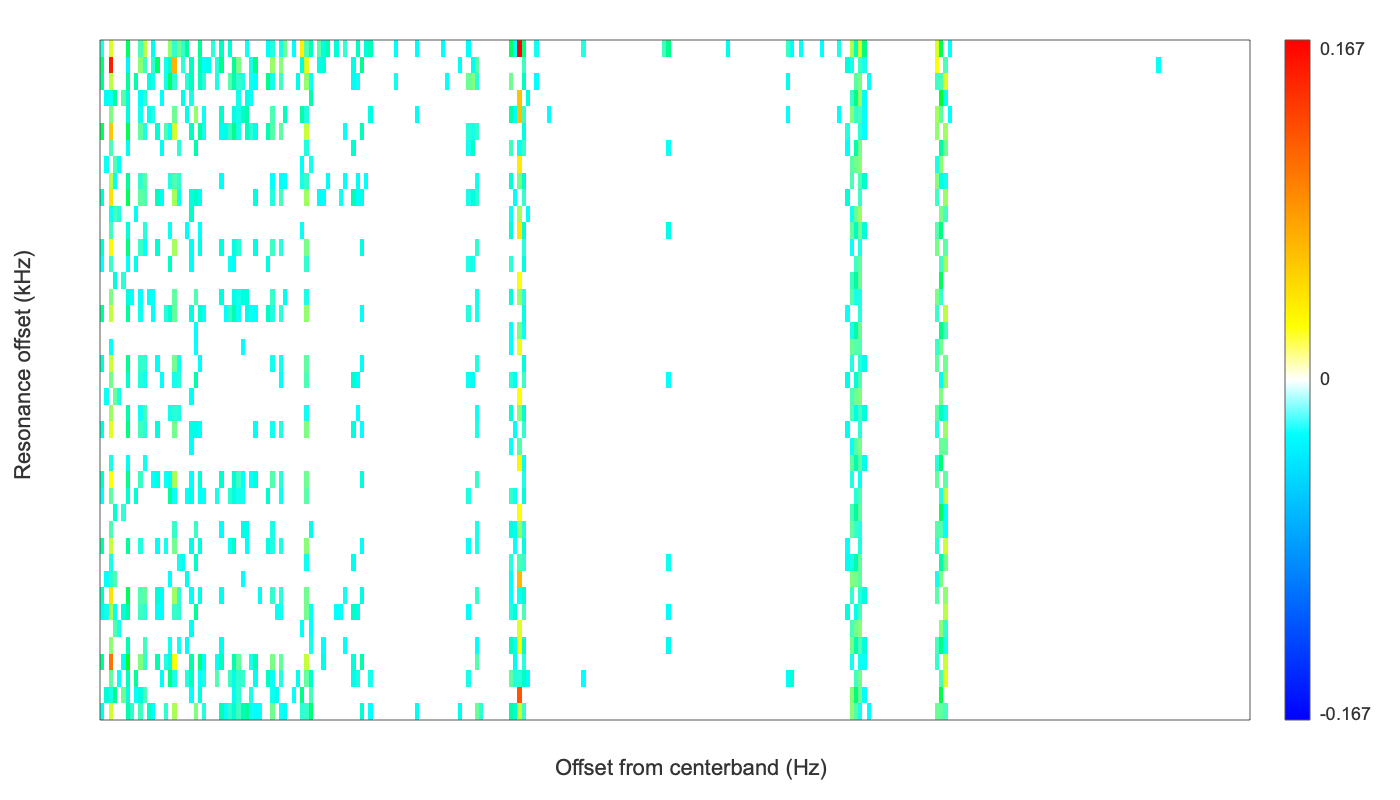
Evaluate predicted decoupling performance across resonance offsets using sideband spectra, RMS residuals, and a two-dimensional intensity map.
Add Your Heading Text Here
Interpret
Turn simulation results into quantitative insight by identifying dominant residual sidebands, spectral concentration, offset dependence, and RF requirements.
Add Your Heading Text Here
Export
Generate the calculated waveform for supported NMR platforms, together with traceability information for reproducibility and experimental records.
How STUD+ works
From experimental constraints to an implementation-ready waveform, STUD+ brings pulse calculation, numerical simulation, scientific interpretation, and export into one workflow.
Define the experiment
Select the known experimental parameters and enter the RF field strength, effective decoupling bandwidth, scalar coupling, or sideband requirement available for your experiment.
Calculate & simulate
STUD+ calculates the pulse parameters and simulates decoupling performance across resonance offsets, including sideband spectra, RMS residuals, and the two-dimensional intensity map.
Inspect & export
Inspect the predicted performance and RF pulse shape, review the numerical interpretation, then generate the waveform for a supported NMR platform together with its export record.
See STUD+ in action
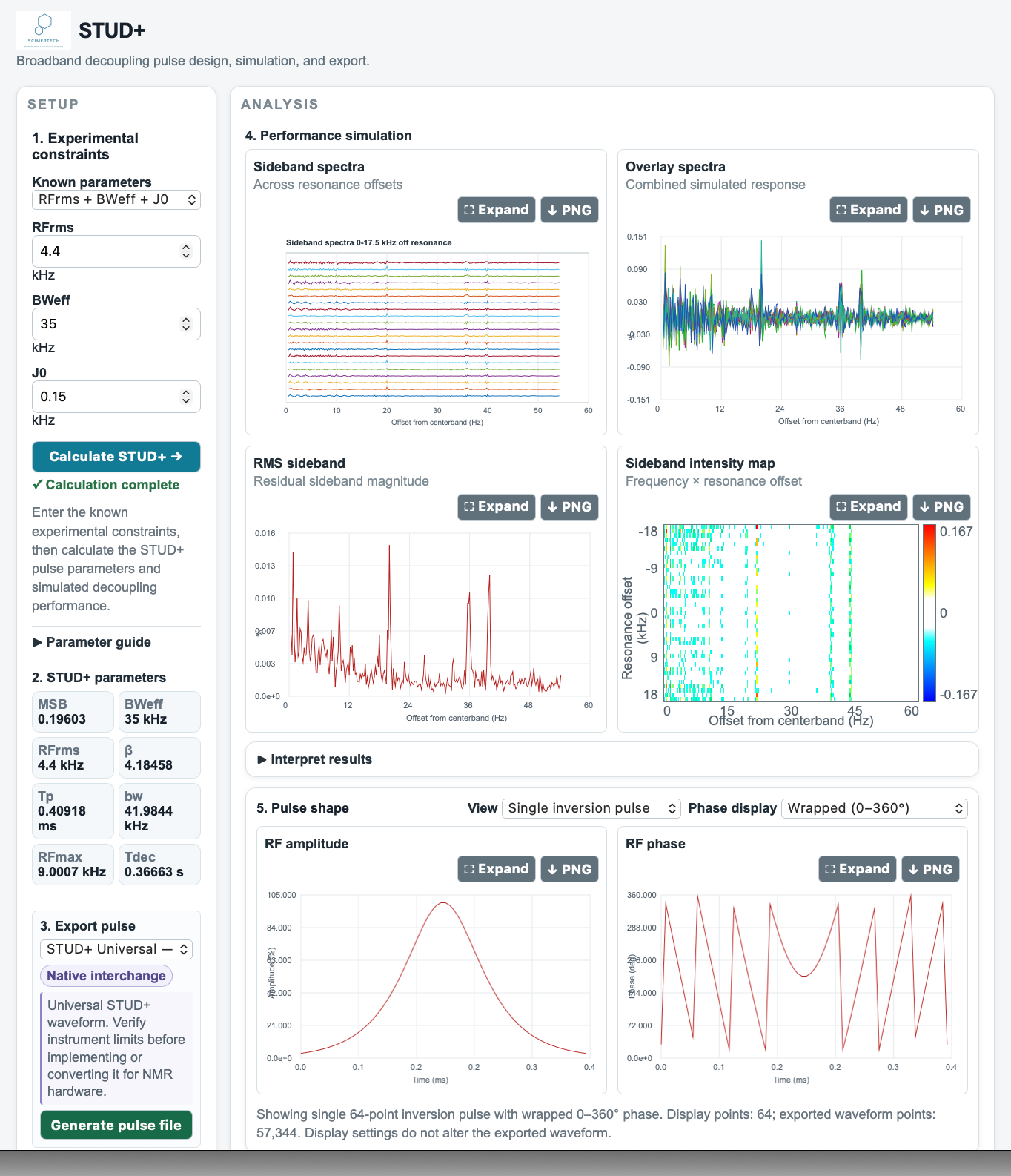
Design, simulate, inspect, and export from a single scientific workspace. STUD+ combines experimental inputs, calculated pulse parameters, performance simulation, pulse-shape visualization, and spectrometer export in one browser-based interface.
Built on published NMR methodology
STUD+ is based on the broadband adiabatic decoupling methodology developed by T. E. Skinner and M. R. Bendall and described in the Journal of Magnetic Resonance.
The method combines adiabatic inversion pulses with phase cycling designed to reduce residual sidebands while providing broadband decoupling under experimentally relevant RF constraints.
The SCIMERTECH implementation brings this methodology into an interactive browser-based workflow for pulse design, numerical simulation, visualization, interpretation, and waveform export.
Scientific validation
The STUD+ web implementation has been cross-validated against the reference MATLAB implementation across multiple parameter-constraint modes.
For the reference waveform, all 57,344 amplitude/phase points reproduced the MATLAB-exported waveform at its numerical export precision.
Calculation parameters, simulated sideband behavior, RMS residuals, resonance-offset maps, and generated waveform structure have been compared against the reference implementation.
57,344 / 57,344
Reference waveform amplitude/phase points reproduced at the MATLAB export precision.
References & scientific collaboration
STUD+ builds on the published work of Prof. Thomas E. Skinner and Prof. Malcolm R. Bendall. The development and scientific validation of the SCIMERTECH STUD+ implementation are being advanced with scientific input from Prof. Thomas E. Skinner, Wright State University.
Foundational references
T. E. Skinner and M. R. Bendall, “A Phase-Cycling Algorithm for Reducing Sidebands in Adiabatic Decoupling,” Journal of Magnetic Resonance 124, 474–478 (1997). DOI: 10.1006/jmre.1996.1061
M. R. Bendall and T. E. Skinner, “Calibration of STUD+ Parameters to Achieve Optimally Efficient Broadband Adiabatic Decoupling in a Single Transient,” Journal of Magnetic Resonance 134, 331–349 (1998). DOI: 10.1006/jmre.1998.1522
Instrument compatibility
STUD+ uses a vendor-neutral waveform representation and provides export options for supported NMR platforms. Compatibility status reflects the current level of implementation and validation.
Bruker TopSpin ✓ Validated
Waveform export validated point-for-point against the reference MATLAB STUD+ output for the tested reference case.
STUD+ Universal Native interchange
Vendor-neutral STUD+ amplitude/phase waveform with calculation and timing metadata.
VnmrJ / OpenVnmrJ ⚠ Experimental
Programmable decoupling export available for evaluation. Instrument-level validation is still required.
Magritek Spinsolve Expert Integration
Waveform representation intended for Spinsolve Expert integration. Not currently presented as a verified native Spinsolve format.
Ready to design your STUD+ pulse?
Design the pulse, simulate its performance, inspect the predicted residual sidebands, and generate the waveform from your browser—without requiring MATLAB on the user’s computer.
Resources
Documentation
Learn how to configure a STUD+ calculation, interpret the simulation, inspect the pulse shape, and export waveforms.
View documentation →
Validation
Review the MATLAB cross-validation, reference waveform comparison, and current validation scope.
View validation →
Scientific references
Explore the published methodology underlying STUD+ and the foundational Journal of Magnetic Resonance papers.
View references →
Terms & safety
Review usage conditions, instrument-verification responsibilities, disclaimer, privacy, and software terms.
View terms →
Frequently asked questions
STUD+ is a browser-based scientific tool for designing broadband adiabatic decoupling pulses from experimental requirements. It calculates the pulse parameters, simulates decoupling performance across resonance offsets, helps interpret residual sidebands, and generates waveforms for supported NMR platforms.
STUD+ is designed to take you from experimental conditions to a calculated pulse in a few clicks. For typical calculations, pulse generation and performance simulation are completed within a fraction of a second, allowing different experimental conditions to be evaluated rapidly.
STUD+ runs through a web browser and brings pulse calculation, performance simulation, visualization, interpretation, and waveform export into a single workflow.
STUD+ generate universal waveform which you can translate to the respective spectromter formate. However, STUD+ currently provides a validated Bruker TopSpin waveform export, a vendor-neutral STUD+ Universal representation, an experimental VnmrJ/OpenVnmrJ export, and a Magritek Spinsolve Expert integration representation. The current compatibility status is displayed clearly in the application.
Users should verify the generated waveform against the RF power, RF amplitude, duty-cycle, probe, amplifier, spectrometer, and other operating limits applicable to their instrument and experiment before implementation.
Yes. STUD+ has been used to design a broadband decoupling pulse for an Environmental Sciences research group in Toronto. In that use case, the available RF field was limited to 4.4 kHz RFrms and the experiment required a 35 kHz effective decoupling bandwidth, with J0 = 150 Hz used for the pulse design.